The recent release of Christopher Nolan’s blockbuster ‘The Odyssey’, based on the ancient text by Homer, was welcomed with much anticipation and expectation. The film, first ever to be shot entirely with IMAX film, promises to be huge having grossed $264m in its opening weekend. Very quickly, two camps seemed to emerge on social media- the lovers or the haters, with very few views in between. Prominent academics have been quick to offer their view. Emily Wilson whose highly regarded 2018 translation was the apparent basis for the film was deeply critical in many respects, stating that she ‘would be ashamed to have written any part of this script’. The esteemed author Joyce Carol Oates countered with a defence of Nolan’s right to reimagine the hero Odysseus in his own terms and for a modern audience and notes that Wilson has benefitted from the film in terms of massively increased sales of her books. The Classicist Mary Beard has also provided her view of the movie: good on the provision of action-packed battle scenes but with a disappointing approach to women. Her overall view was that it was a movie worth watching, but the ‘elusive sexiness’ of the original text was lost.
Having seen The Odyssey twice- once in the bourgeois comfort on a small screen in my local Everyman and once on the big screen IMAX version- these are my thoughts. I’ll start off with a summary of the poem itself then I’ll deal with the major criticisms.
The Poem
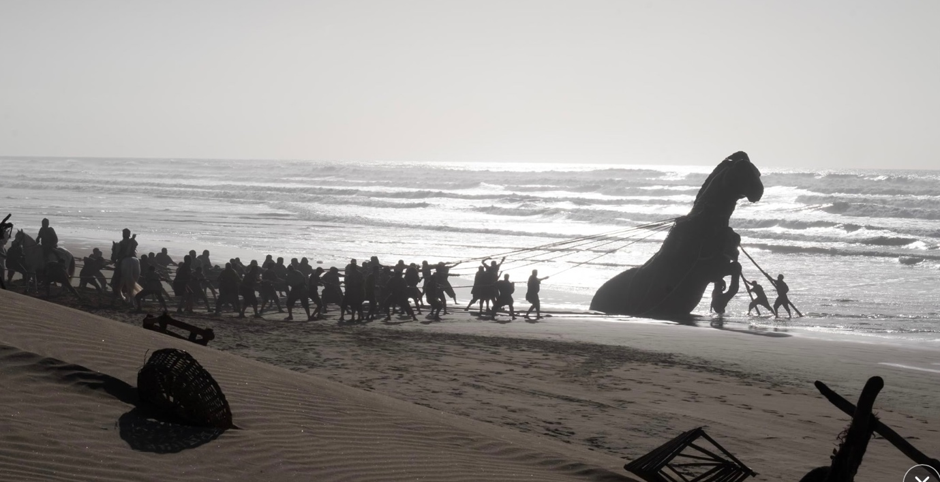
The Odyssey is an epic poem, presumed to have been written around the eighth century BCE, following a long oral tradition. Whether there was indeed one author called Homer is much debated and unresolved. The poem tells the story of the journey of Odysseus back to his home on the island of Ithaca after the defeat of Troy by the Greeks. Much of the action, such as the wooden horse, and various escapades, is told in retrospect by various bards and Odysseus himself. The main premise is that of the Homeric hero who sought kleos (or glory) in war: murder, rape, pillage and enslavement of captured peoples’ was expected and celebrated. The reason for the doomed return of many of the Greeks was retribution from the gods in desecrating the temples of Troy, and in the particular case of Odysseus and his men, the blinding of the Cyclops Polyphemus (who was a son of Poseidon) and the slaughter of the Cattle of Helios, resulting in divine vengeance by Zeus.
Meanwhile, Odysseus’ wise and beautiful wife Penelope is besieged by suitors wishing to marry her and take up the kingship of Ithaca. These suitors, one of the main ones being Antinous, exploit the sacred duty of xenia (or guest friendship) to overrun her home. The young son of Odysseus called Telemachus is around twenty at this point and lacks the experience and inner strength to effectively deal with the suitors. When Athena appears to him in disguise he sets sail on his own journey to find news of his father, a journey which yields no news. Meanwhile, Odysseus has many adventures, including coming under the spell of two sorceresses, Circe and Calypso, eventually returning home disguised as a beggar, where he enlists the help of Telemachus to assassinate the suitors.
The Film
Let’s discuss Christopher Nolan’s The Odyssey by addressing some of the major criticisms. One criticism is that the gods were not depicted, apart from Athena’s appearances to Odysseus at various points in the film. I think this was a good choice: the depiction of Greek gods does not tend to sit easily with a modern audience. There were plenty of referrals to the gods in the context of the adverse events occurring to the sailors throughout the film, and it was always made clear that characters such as Polyphemus and the cattle of Helios were intimately connected to the gods. The apparent aberration of the depiction of the goddess Athena will be discussed later.
Another major criticism of the film involves that of the casting of the Kenyan-Mexican actress Lupita Nyong’o as Helen of Troy. The casting of a black actress to play Helen of Troy caused some controversy prior to the film’s release, leading to the accusation that this choice may have been made at least partly to engender controversy. As Mary Beard states, Western society is not used to thinking of Helen of Troy as being anything other than a white woman. The reasons for this are complex, but ultimately, I would agree with Beard that this is a moot point- Helen is after all a fictional character. That she was fathered by Zeus and born from an egg may give us a clue! In the movie Nyong’o also played Clytemnestra who was explained as her twin sister, as opposed to the half-sister relationship described by Homer, which gave this excellent actress slightly more screen time (although not nearly enough).
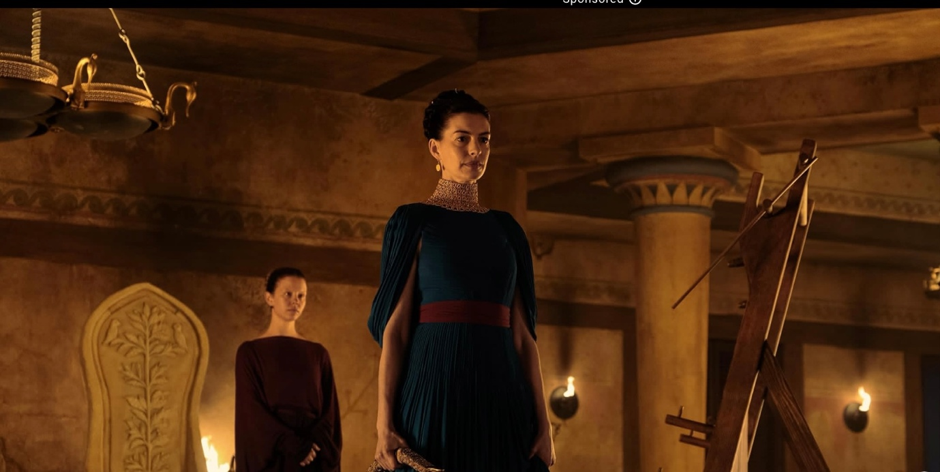
Wilson and Beard both agree that female characterisation in the film is generally lacking, with Beard in particular noting that Homer presents many strong female characters in the text, including the Phaeacians and the strong-willed Princess Nausicaa, which Nolan chooses to omit. This was not a problem for me per se: I would have expected many scenes and characters from the text to be cut to fit what is still a very long film with an almost 3 hour running time. Some female characters were well depicted. Homer presents very well the intelligence and quiet desperation of Penelope anxiously wishing for her husband’s return and Anne Hathaway very ably reflects this. The difficulty Penelope experiences is encapsulated in her terse rebuke to her son: ‘in this world, men do what they like, I do what I must’. The test Penelope sets for the suitors of stringing her husband’s bow and firing through the axes is straight from the text and lends itself very well to the big screen. However, I must confess to some disappointment that there was no attempt to recreate their marital bed, which according to the original text was built on a tree growing in the house. Having managed such an excellent and iconic depiction of the Trojan horse, surely this would have been possible?
Another excellent female depiction was Samantha Morton as the witch Circe. Although Odysseus’s time with her was curtailed to what seemed like only a few hours, as opposed to the year he spent with her in the poem, Morton’s chilling depiction involving turning Odysseus’s men into pigs was cinematically stunning, with Circe later offering her explanation to Odysseus. Simply put, single women in the Homeric world constantly faced threat of danger from the patriarchy, and Circe turned his men into what she considered they already were- pigs. A stunning characterisation from a wonderful actress, with Nolan noting in one interview that this was one of the few occasions in his films where the cast spontaneously applauded after it was filmed. Unfortunately, other female characterisations were severely lacking, particularly Nyong’o in her portrayal of Helen of Troy. Nyong’o competently depicted Helen as a bitter victim of ongoing domestic violence in the time allotted to her but was unfortunately provided with no opportunity for character development. Other female characters were similarly underdeveloped.
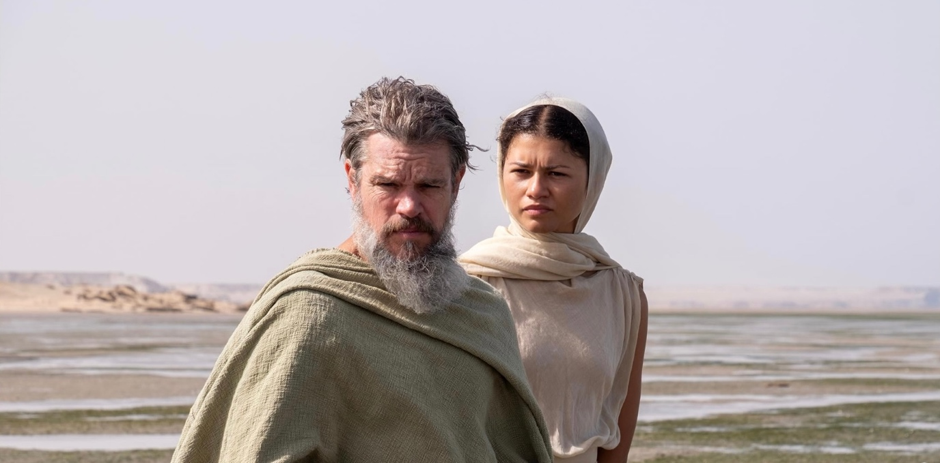
Now to turn to a further criticism of the film. Wilson complains that ‘Damon’s Odysseus isn’t complicated or wily or artful’. I would dispute this: at all stages, from Odysseus’s planning of the fall of Troy using the wooden horse, through the various tests such as the escapes from Circe, Cyclopes, Scylla to his eventual return home and overthrow of the suitors, Odysseus faithfully followed the text: he was brave and clever and suitably wily. The essential change between text and film is that Nolan chose to show him in flashback through the destruction of Troy as a man of instant regret and distress. His subsequent persona was one of the returning hero with psychological trauma. It also becomes apparent near the end of the film that the manifestations of Athena (played by Zendaya) were based on a female (possibly a priestess) being beheaded during the battle in Troy at the same time as Athena’s statue. The Athena of the film was therefore not a true god but a manifestation of Odysseus’s PTSD, with him interpreting these apparitions as visits from the goddess Athena.
A final criticism of the film is that, at various points, there was discussion of ‘the people of the sea’ who would one day attack their ordered world and ultimately bring an end to their society. This is not present at any point in Homer’s text and I felt it was wholly unnecessary and confusing. It is thought that this notion likely relates to contemporary American concerns regarding empire and their place in a global world. This is discussed by Mary Beard (check my bibliography)- well worth a look.
Conclusion
Despite the numerous criticisms I have outlined (particularly the patchy female characterisation) I would highly recommend seeing this movie, which faithfully depicted the homecoming of Odysseus in many respects. In changing the essential premise of the movie, from that of retribution by the gods on the victors of the Trojan War because of their lack of respect to the gods, to a rather more modern depiction of the horrors of war with the return of a psychologically damaged war hero, Nolan has managed to tread the tightrope between faithful depiction of a classic text whilst making an acceptable adaptation for a modern Western audience. No mean feat.
What I hope most of all is that viewers of the film will be persuaded to read the original text and make their own comparisons. I hope you enjoy it!
Bibliography
- Beard, M. (2026) ‘Mary Beard on The Odyssey and how empires fall- stateside with Kai and Carter’ [Online]. Available at https://www.theguardian.com/us-news/video/2026/jul/20/the-odyssey-nolan–mary-beard-stateside-podcast (Accessed 4 August 2026).
- Shard, C. (2026) ‘The crude language of MAGA folks’: Joyce Carol Oates criticises Emily Wilson for criticising Nolan’s Odyssey, The Guardian 30 July 2026 [Online]. Available at https://www.theguardian.com/film/2026/jul/30/maga-joyce-carol-oates-criticises-emily-wilson-for-criticising-nolans-odyssey (Accessed 5 August 2026).
- The Odyssey, Homer. Emily Wilson (trans.) (2018) Norton & Company, London.
- The Odyssey, Nolan, C. (2026) IMDb [Online]. Available at https://www.imdb.com/title/tt33764258/ (Accessed 4 August 2026).
- Wilson, E. (2026) ‘An Uncomplicated Man’, London Review of Books Vol. 48 No. 14, 13 August 2026 [online]. Available at https://www.lrb.co.uk/the-paper/v48/n14/emily-wilson/an-uncomplicated-man (Accessed 4 August 2026).


Leave a Reply