Remarkably little is known about the Celts of Ancient Britain. This is largely due to the fact that they had an oral tradition for passing on information regarding their lifestyle and beliefs, rather than the written word. Due to this absence of a written tradition much of our understanding comes from Roman written sources who often portrayed the Celts as primitive warring societies: a concept which persists to the present day.
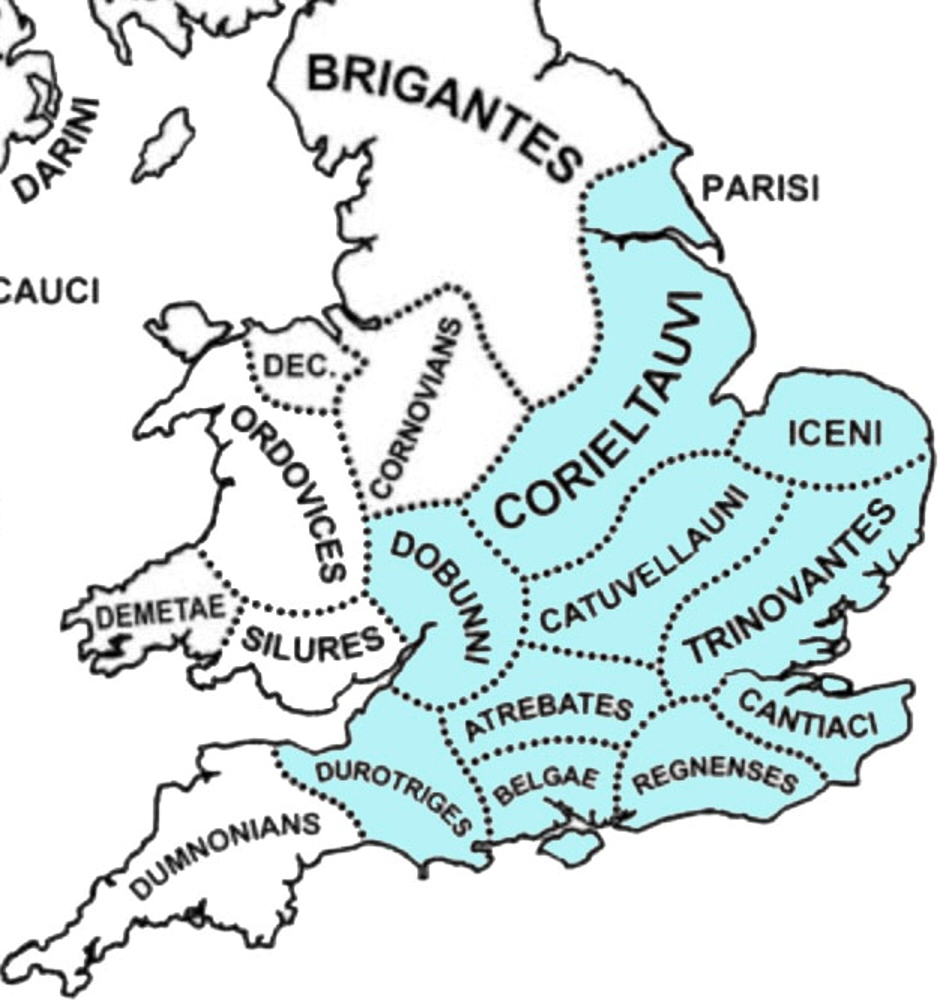
Coinage can tell us much about the beliefs and ideals of a society. This is usually correlated with other sources such as written evidence, archaeology and material culture. Ancient British Coins were produced by some British tribes in the first century BCE (Fig. 1). Coins were initially produced as a means of funding resistance to Roman occupation and subsequently as a means of paying taxes once Roman occupation was established. Is it possible to glean information about the beliefs and ideals of the Celts of Ancient Britain from their coins? This is notoriously difficult due to the fact that Celtic coins are generally highly stylised and our lack of written sources regarding Celtic life and mythology means that they are often difficult to interpret. However, in this post I will look at Julius Caesar’s self-penned contemporaneous account of the Gallic Wars in the light of a poorly understood reverse of a coin from the Durotriges tribe of modern Dorset. This will provide us with an indication that the Celts of Ancient Britain almost certainly had a sophisticated knowledge of astronomy.
Caesar’s View of The Celts
Julius Caesar’s Gallic Wars took place between 58 and 50 BCE, culminating in the conquest of Gaul. The Romans invaded Britain in 55/54 BCE although whether this was a true invasion or not is debatable. Part of Caesar’s remit may have been as a reconnaissance to scout for natural resources, of which there were precious little, apart from a supply of tin. Caesar certainly established some client kings and the payment of taxes, but he did not leave an occupying army. Full occupation of Britain did not in fact occur until around 100 years later in 43 CE under the reign of the Emperor Claudius.
In Caesar’s own account of the Gallic wars, he describes the two orders of elite Celtic society- the Knights (or noble men) and the Druids. The Druids were the religious leaders, who were exempt from going to war or paying taxes and were responsible for religious worship, sacrifices and also acted as judges in disputes and crimes. Due to their high status in Celtic society, this was a sought after position. The training was long, up to twenty years, and necessitated learning by heart a vast amount of oral information. It was unlawful to write down this information although for other purposes they had a knowledge of Greek language. Caesar’s view that this aim to commit religious instruction to memory only was twofold: to avoid passing on important religious information to the masses and to ensure the Druids were fully engaged with learning. The Druids taught reincarnation and Caesar attributed this belief to the valour the Celts exhibited- after all, if you believe your soul is immortal you are less likely to fear death. Caesar also wrote that the Druids imparted knowledge of ‘the stars and their motion’ and respect to the earth and the gods (Caesar, Gallic Wars, 6: 13-15).
The Coin
The image to be discussed is the reverse of a silver stater from the Durotriges tribe of modern Dorset from the Hunterian collection in Glasgow. This dates to around 60- 20 BCE (Fig. 2). Of note is that this was around the time of Roman incursions into Britain by Julius Caesar in 55-54 BCE. These coins were produced in large quantities initially to fund the resistance to the Romans and later to pay tribute to them.
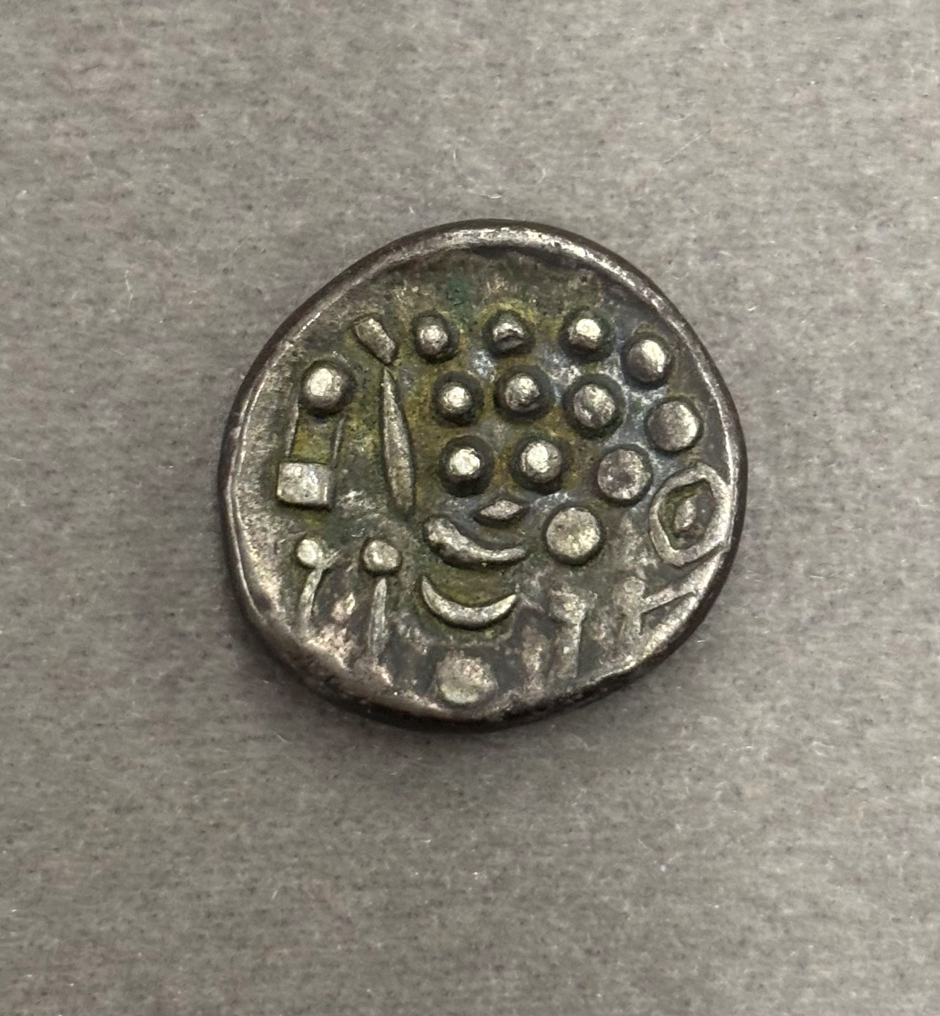
This depiction is known as the ‘Cranborne Chase’ horse after the N. Dorset/ S. Wilts. estates of the father of British archaeology, Lt. General Augustus Lane-Fox Pitt-Rivers (1827-1900). It depicts a highly stylised horse with a ‘padlock’ type head at 9 o’clock, a body composed of 2 crescents, 4 vertical legs, a large circular pellet below and a ‘coffee bean’ motif at the rear of the horse (this is considered by some authorities to represent a wheel, others suggest a shield, but it’s significance is basically unknown). The horse appears to be carrying 12 discs- this number is constant throughout this type of coinage and is considered by numismatic experts to be related to the lunar calendar, each disc representing one complete cycle of the moon’s phases.
Have a close look at the bottom of the pile of discs. I have highlighted this in Figure 3.
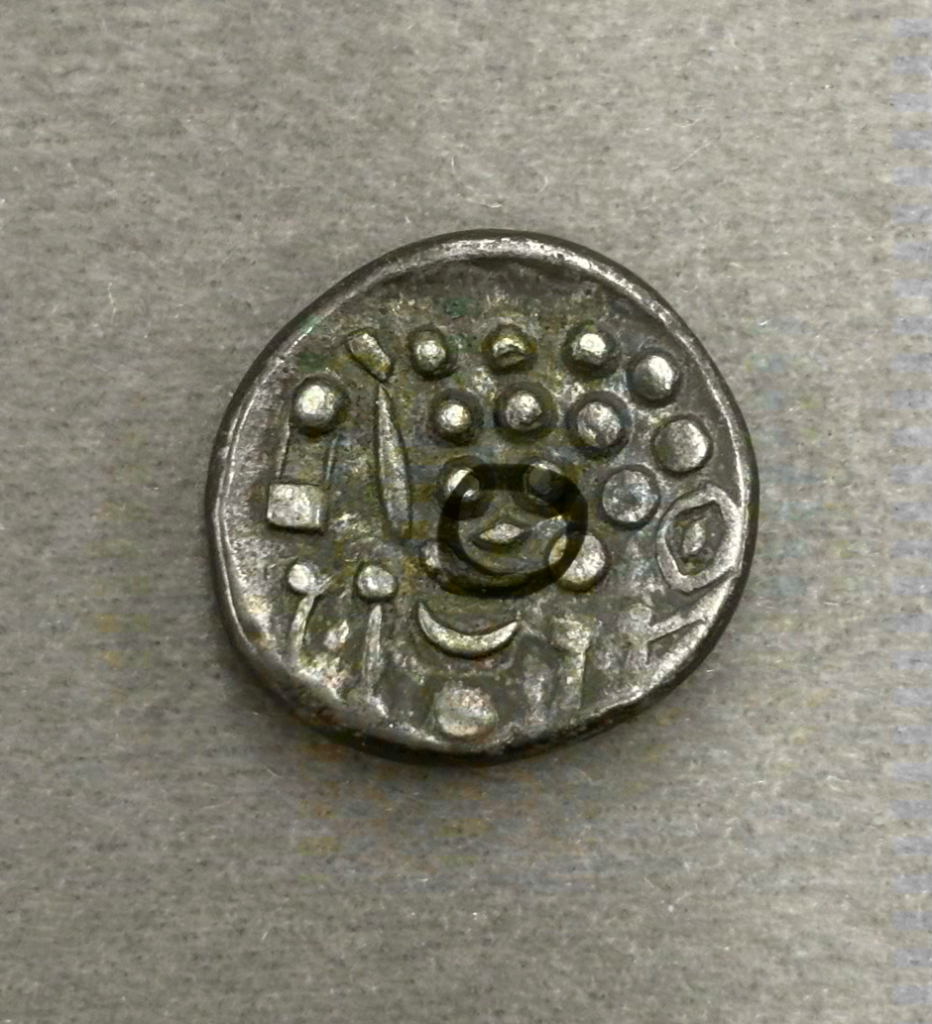
This extra little pellet is highly significant. Here’s why.
A lunar calendar measures time based on the moon’s full cycle (from new moon to new moon), which takes 29.5 days. A pure lunar calendar, such as the Islamic calendar, which is used to determine religious dates such as Ramadan, consists of 12 lunar months. This equates to 354 days, and because it is 11 days shorter than a solar year, is inaccurate in terms of coinciding with the seasons. Importantly, a farmer would not be able to use this to regulate his crops. Therefore a solar calendar is the preferred option, where extra days are added at certain intervals. The Durotriges tribe have effectively acknowledged this problem by converting this representation into a solar calendar: an extra 1/3rd pellet has been added, transforming this image into one representing 12.37 synodic (lunar) months- an accurate reflection of a solar year. At the time of Caesar’s invasion of Britain in 55/54 BCE, and around the time this coin was produced, the Roman calendar was a lunar one: it was highly inaccurate and in urgent need of reform. If we accept this interpretation of the depiction on this Durotrigan coin, it would indicate that the Druids were rather more sophisticated in their understanding of mathematics and astronomy than their Roman counterparts. After Caesar’s return to Rome in 45 BCE he reformed the old Roman lunar calendar to one which is familiar to us today, composed of 365 days with a leap year every 4 years. Whether he was influenced by the Druids is not documented and he is credited with having amassed this information from the Egyptians.
Conclusion
To conclude, the lunar horse is representative of how Celtic people viewed their universe: the waxing and waning of the moon’s cycle was explained in terms of a cosmic lunar horse, carrying the 12 and 1/3 discs of the full moon and dispersing them in the sky in order to align with the moon and the seasons- a true solar calendar. This is a depiction which was represented on the coins of the Durotriges and Belgae tribes of Southern England and was likely to have represented a cult object which was worshipped in temples and other religious spaces. This image would have been much revered and would have been readily identified on coins, certainly by the Celts of the Durotriges and Belgae tribes, and likely much wider throughout the Celtic world. The observation by Julius Caesar that these Celtic Druids imparted knowledge of ‘the stars and their motion’ is certainly borne out by the wonderful depiction that is the Celtic Lunar Horse.
Bibliography
Ancient Scholarship:
- Julius Caesar, The Gallic Wars, (Ed. F. Ruedele), Neptune Publishing, U.K.
Modern Scholarship:
- Celtic Coin Index (1961) Oxford University [Online]. Available at https://cci.arch.ox.ac.uk/ (Accessed 11 June 2026).
- Cottam, E., De Jersey, P., Rudd, C., Sills, J. (2010) Ancient British Coins, Chris Rudd, Aylsham.
- Green, M. (1995) The Celtic World, Routledge, London.
- Nash Briggs, D. (2009) ‘Reading the Images on Iron Age Coins: 2. Horses of the Day and Night’, List 106, in Rudd, C. (2024) Celtic Coin Articles from the Chris Rudd Catalogues, Chris Rudd Ltd, Norwich.
- Robinson, D. (2024) Durotrigan Quarter Staters, Amazon.


Leave a Reply