The ancient Greek myth of Medusa is one which has very successfully persisted into modern popular culture: most people are aware of the version of the myth where Medusa is a hideous monster with a head full of snakes, who can turn men into stone. More recently, Medusa has become a representative of sexual assault and revenge against the patriarchy, and a potent symbol of the #MeToo movement.
Origin
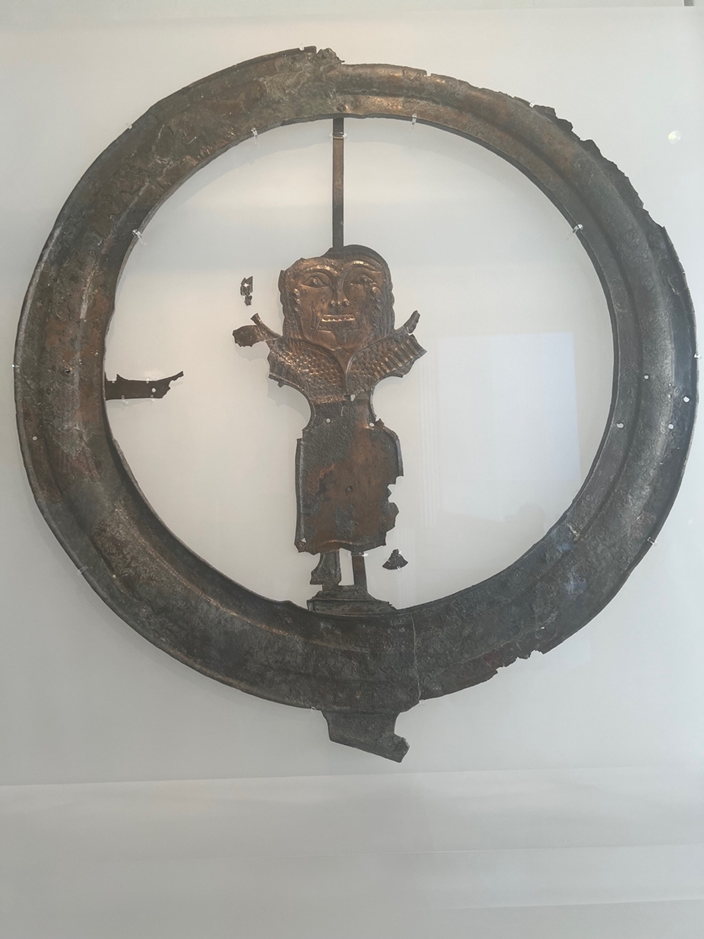
Medusa is believed to have derived from the gorgoneion, one of the oldest symbols in antiquity from the eighth century BCE, which possibly in turn had Near Eastern origins. She was often depicted with a beard, fangs and protruding tongue (Fig. 1).

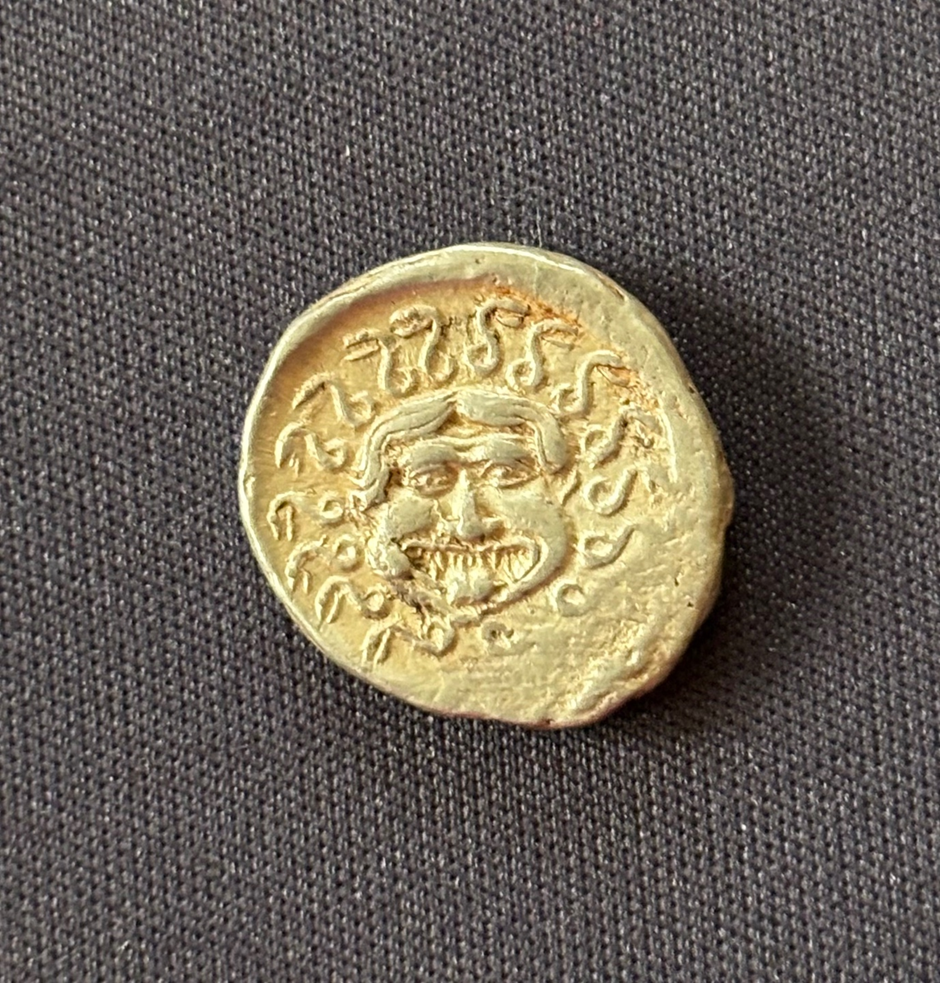
These figures served as apotropaic devices i.e. having the power to avert evil or bad luck, and were found in many sites, such as shields, temple pediments, pottery, mosaics and, of course, coins (Fig. 2).
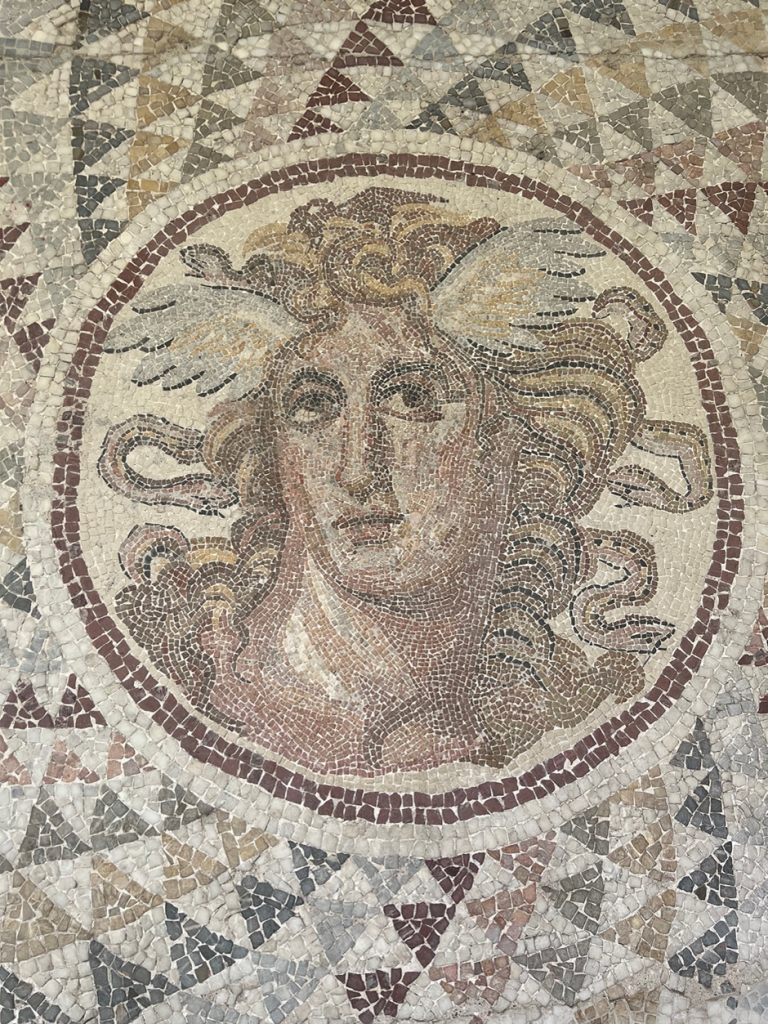
It is thought by some scholars that the myth of Medusa later developed to explain the gorgoneion (Deacy et al, 2016:825), with later depictions demonstrating her in full body and running mode (Fig. 3). By the Classical period from around the fourth century BCE, Medusa had become a beautiful young woman with snake entwined hair and was often depicted with wings to emphasise her other worldliness (Fig. 4) (Wilk, 2000: 33-35).
Myths
Many versions of the Medusa Myth existed in ancient mythology. However, the version which has persisted into modernity is that of the Roman poet Ovid, who described her as a beautiful woman who was raped by Neptune in the temple of Minerva. The goddess punished Medusa by transforming her hair into snakes, her horrific appearance turning men to stone with her gaze. Ovid recounts Medusa’s narrative as one of transformation into a monster, although whether this transformation rendered her mute is unknown. Medusa subsequently became the subject of the hero Perseus’s quest to obtain the head of a Gorgon, decapitating her as she slept (Ovid, Metamorphoses 4.771-803). The prize of Medusa’s head became a source of power for Perseus, enabling him to fight battles successfully and ultimately win the prize of Andromeda.
However, there are other lesser known versions of the Medusa myth which are just as intriguing. The ancient writers Diodorus Siculus, Palaephatus and Pausanias described her as a leader of a matriarchal race of female warriors in the Tritonis area of Africa. The Medusa of these writers was not a monster, and the gods were absent from her narrative, yet she represented a figure which was immensely threatening to this patriarchal ancient world- a successful female ruler.
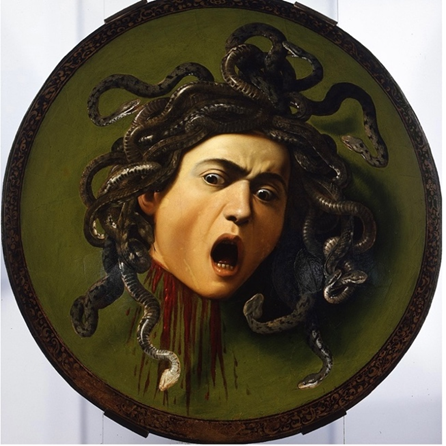
Nevertheless, it was the depiction by Ovid of the beautiful rape victim punished by the gods which persisted throughout the Medieval and Renaissance periods and into modernity, partly due to the popularity of Latin texts in the monasteries of the twelfth century CE (Reynolds and Wilson, 2013: 111-122). Medusa came to represent Woman in these times: the beautiful and dangerous monster who was a threat to men.
The idea of Medusa as a femme fatale endured throughout the Renaissance and beyond (Fig. 5). This suited the Christian agenda of the time- the erotic presence of Woman denying men the opportunity for moral virtue and reasoning (Leeming, 2013: 40-43).
Twenty First Century Medusa
The late twentieth century saw the advent of a feminist reclaiming of Medusa, both as a victim of the patriarchy and one who is capable of retribution, becoming a potent symbol of the #MeToo Movement of the early 2000s (Fig. 6). In particular, the fact that Medusa as a victim of sexual assault was not given her own voice and her story rather told by male authors, has come to represent the difficulties modern rape survivors encounter in having their voice heard.
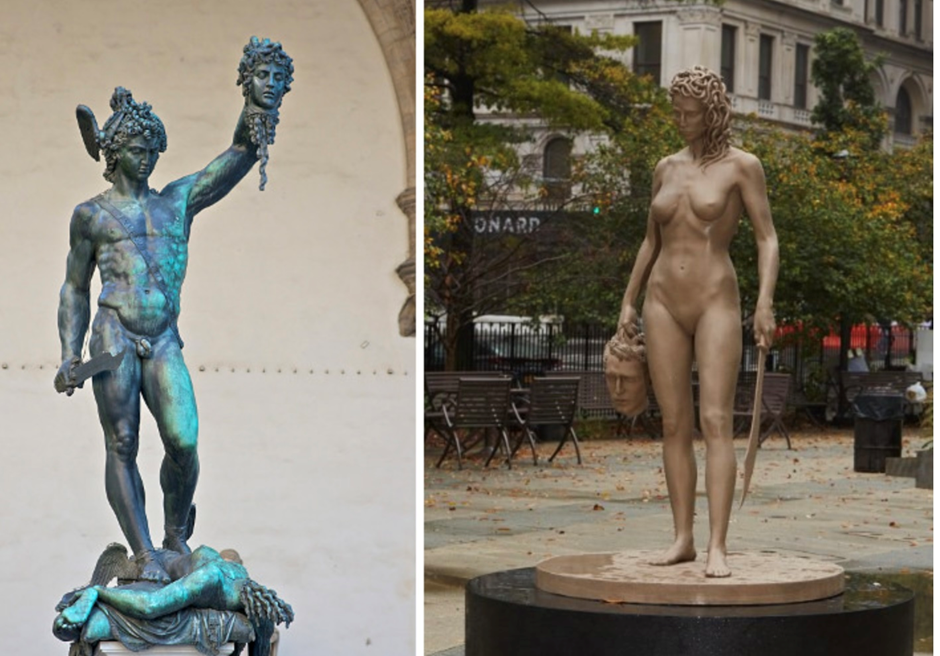
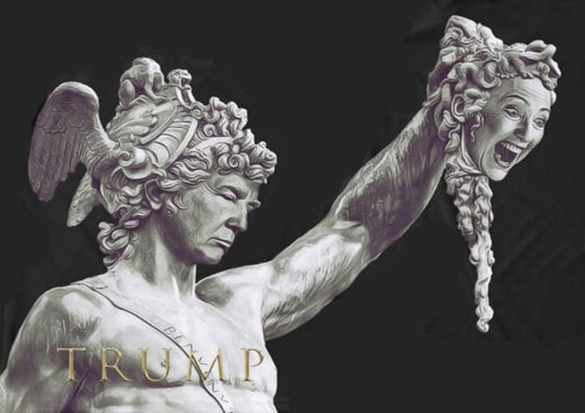
Medusa continues to inspire in modern times and has become ubiquitous in modern culture such as cinema, literature, comic books, video games and tattoos (Fig. 7) (Duffy, 2020: 2-3). She has also been used in political memes, such as in the savage battle between Donald Trump and Hillary Clinton in the 2016 USA presidential election (Fig. 8). Mary Beard (2017: 10-13) argues that this particular image demonstrates the normalisation of gendered violence.

Films
The 2021 films Black Medusa and Photocopier provide indirect receptions of the Medusa myth, that is, involving unrelated characters who identify with certain aspects of Medusa’s persona, and are useful in their exploration of themes of sexual assault and female retribution.
Black Medusa is a vengeance noir thriller set in modern day Tunisia and tells the story of the beautiful Nada, rendered mute by a previous sexual assault, who works as a digital editor during the day and spends her nights drugging, raping and murdering men she meets in the bars of Tunis (Fig. 9).

Photocopier is the story of Sur, who is drugged at a party and loses her college scholarship when inappropriate photos of her are distributed online. Her investigation reveals that the perpetrator is the son of a prominent businessmen and her accusations are not listened to by the authorities. It is only when Sur finds other victims of abuse and collaborates with them that she is eventually vindicated (Fig. 10). These concepts of victims not being heard, particularly where powerful men are involved, and women having to join forces to influence society to take them seriously, are obviously reminiscent of the #MeToo movement.

Medusa has also been depicted in the Percy Jackson movies and TV series based on the best-selling books by the American author Rick Riordan. Percy Jackson and the Olympians: The Lightening Thief (2010) tells the story of Percy, a teenage student in modern day America, who discovers that his biological father is in fact the god Poseidon. As a demigod, Percy must locate Zeus’s thunderbolt which has gone missing. Cue lots of supernatural adventures, including an encounter with Uma Thurman as Medusa, who is the proprietor of a garden centre populated by statues- all of them unfortunate victims of Medusa’s gaze. See Percy’s battle with Medusa here:
Conclusion
To conclude, Medusa is one of the most ancient figures from Classical mythology. Her popularity has persisted throughout time, such that she continues to inspire and invoke discussion on aspects of patriarchy, victimhood and female retribution: the ultimate survivor.
Bibliography
Primary sources:
- Ovid, Metamorphoses, in Raeburn, D. (trans.) (2004) Penguin, London.
Modern scholarship:
- Beard, M. (2017) ‘Women in Power: from Medusa to Merkel’, London Review of Books, Vol. 39, No. 6, 16 March 2017, pp.1-14 [Online]. Available at https://www.lrb.co.uk/the-paper/v39/n06/mary-beard/women-in-power (Accessed 21 November 2025).
- Black Medusa (2021) IMDb [Online]. Available at https://www.imdb.com/title/tt13742892/ (Accessed 21 November 2025).
- Deacy, S., Hanesworth, P., Hawes, G., Ogden, D. (2016) ‘Beheading the Gorgon: Myth, Symbolism and Appropriation’ in Goffredo, S., Dubinsky, Z. (eds.) (2016) The Cnidaria, Past, Present, Future, Springer International Publishing, Switzerland, pp.823-834 [Online]. Available at https://link.springer.com/chapter/10.1007/978-3-319-31305-4_51 (Accessed 21 November 2025).
- Duffy, W. (2020) ‘Medusa as Victim and Tool of Male Aggression’, Verbum Incarnatum: An Academic Journal of Social Justice: Vol. 7, Article 1, pp. 1-14 [Online]. Available at https://athenaeum.uiw.edu/cgi/viewcontent.cgi?article=1073&context=verbumincarnatum (Accessed 21 November 2025).
- Leeming, D. (2013) Medusa: In the Mirror of Time, Reaktion Books Ltd., London.
- Photocopier (2021) IMDb [Online]. Available at https://www.imdb.com/title/tt13729220/ (Accessed 21 November 2025).
- Percy Jackson and the Lightening Thief (2010) IMDb [Online]. Available at https://www.imdb.com/title/tt0814255/(Accessed 21 November 2025).
- Reynolds, L., Wilson, N. (2013) Scribes and Scholars: A Guide to the Transmission of Greek & Latin Literature (4th. ed.), Oxford University Press, Oxford.
- Wilk, S. (2000) Medusa: Solving the Mystery of the Gorgon, Oxford University Press, Oxford.

Leave a Reply